Explain Funnel Chart
A funnel chart shows sequential stages and how volume shrinks from one to the next. It answers: Where do we lose people? What’s the conversion at each step?
What is a Funnel Chart?
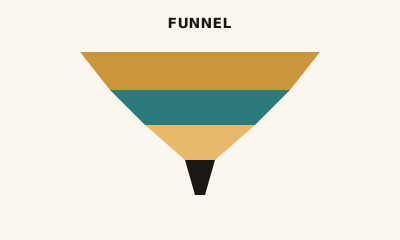
A funnel chart is a set of tiers, each a stage in a process. Width or height represents volume (count or value). The shape narrows to show drop-off. Stages are ordered (e.g. visit → signup → paid) and use the same unit.
When to use a Funnel Chart
Use a funnel when you have sequential stages and want to show conversion or drop-off—e.g. signup → trial → paid, or visit → add to cart → purchase. Fits sales pipelines, marketing campaigns, and onboarding. Keep to about 4–8 stages so each tier is readable.
How to read a Funnel Chart
Each tier is a stage; size is volume. Compare tiers to see where volume drops. The narrowing shape shows the conversion story. Use labels for exact counts or rates.
Common mistakes
Too many stages; mixing units (e.g. revenue in one tier, count in another); unclear stage order.
Variations
Classic funnel (narrowing down); reversed or inverted for growth; with conversion-rate labels.
Funnel Chart in BI tools
Funnel charts are in Tableau, Power BI, Sigma, Looker, and Google Analytics. Use for conversion and pipeline views.
vs. other charts
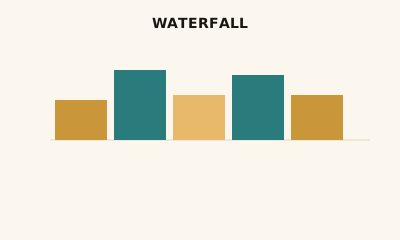
Choose a funnel over a waterfall when you’re showing stage volume and drop-off, not additive/subtractive steps to a total. Use a waterfall for bridges (e.g. revenue to profit) or variance breakdown.
FAQ
When should I use a funnel chart?
Use a funnel chart when you have sequential stages and want to show drop-off or conversion—e.g., signup → trial → paid, or visit → add to cart → purchase. Great for sales pipelines, marketing campaigns, and onboarding.
What do the funnel stages represent?
Each stage is a step in a process; width or height represents volume (count or value). The narrowing shape shows how many drop off at each step. Stages should be ordered and comparable (same unit, e.g., count of users).
Funnel chart vs. waterfall chart?
Funnels show sequential stages with decreasing (or sometimes increasing) volume; waterfalls show how a single value changes through positive and negative steps to an end total. Use a funnel for conversion stages; use a waterfall for financial bridges or variance breakdown.
How many stages should a funnel have?
Keep to 4–8 stages so each tier is readable. Too many stages make the chart crowded; too few may not tell the story. Group minor steps if needed, and ensure each stage is clearly labeled.
Have a chart you can't figure out?
Paste any chart screenshot and get a plain-English explanation in seconds.
Upload your chart →