Explain Waterfall Chart
A waterfall chart shows how a starting value becomes an ending value through a series of positive and negative steps. It answers: How did we get from A to B?
What is a Waterfall Chart?
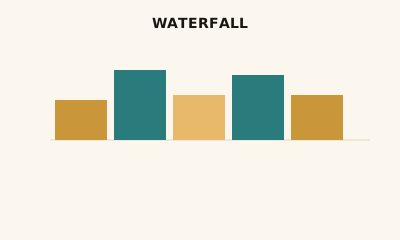
A waterfall chart has a starting bar, then a sequence of bars for each change (up = positive, down = negative), and an ending bar. Connector lines or position show the running total. It’s a bridge view: start + changes = end.
When to use a Waterfall Chart
Use a waterfall when you need to explain how one value becomes another through additive and subtractive steps—e.g. P&L bridge (revenue to profit), budget vs. actual, cash flow. Common in finance and variance analysis.
How to read a Waterfall Chart
Read the first bar (starting value). Each following bar is a change; up is positive, down is negative. The last bar is the end value. Use labels to see the running total after each step.
Common mistakes
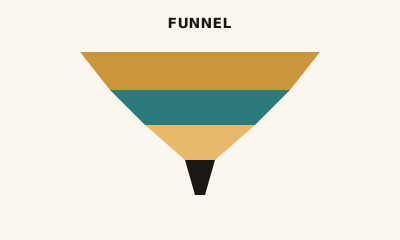
Unclear order of steps; missing labels so the running total is hard to follow; using a waterfall when a funnel (stage volume) would be clearer.
Variations
Classic bridge (start → steps → end); with subtotals; horizontal or vertical.
Waterfall Chart in BI tools
Waterfall charts are in Tableau, Power BI, and Excel. Use for bridge and variance analysis.
vs. other charts
Choose a waterfall over a bar chart when the story is “how did we get from A to B?” Choose a funnel when you’re showing stage volume and conversion, not additive steps.
FAQ
When should I use a waterfall chart?
Use a waterfall chart when you need to show how a starting value becomes an ending value through a series of positive and negative steps—e.g., P&L bridge (revenue to profit), budget variance (planned vs. actual), or cash flow breakdown.
How do I read a waterfall chart?
Start with the first bar (starting value). Each following bar shows a change: positive (up) or negative (down). The last bar is the ending value. Connector lines or position show the running total after each step.
Waterfall vs. bar chart?
Waterfall bars show sequential changes from a baseline; bar charts compare independent categories. Use a waterfall for "how did we get from A to B?"; use a bar chart for "how do these categories compare?"
What are common uses of waterfall charts?
Common in finance: profit bridges (revenue − costs = profit), budget vs. actual, and cash flow. Also used for inventory reconciliation, headcount change, and any story where you add and subtract steps to reach a total.
Have a chart you can't figure out?
Paste any chart screenshot and get a plain-English explanation in seconds.
Upload your chart →