Explain Heatmap
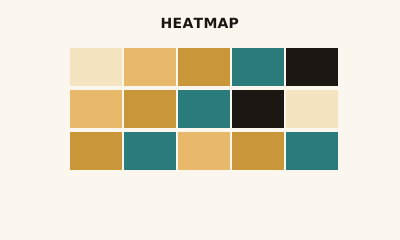
A heatmap shows a measure as color in a grid. Two dimensions define the rows and columns; color intensity shows the value. Good for spotting patterns and extremes.
What is a Heatmap?
A heatmap is a grid of cells. Rows and columns are two dimensions (e.g. time and category, or day and hour); each cell’s color encodes a measure. Darker or stronger color usually means higher value. A legend maps color to scale.
When to use a Heatmap
Use a heatmap when you have two dimensions and one measure best shown as intensity—e.g. activity by day and hour, performance by category and region. It answers “where are the highs and lows?” and “what’s the pattern?” Avoid when viewers need exact numbers at a glance; use a table or bar chart then.
How to read a Heatmap
Identify the row and column for each cell, then use the color legend to read the value. Compare cells to see which combinations are high or low. Look for bands, blocks, or empty areas that form a pattern.
Common mistakes
No legend or unclear scale; too many rows/columns so the grid is cramped; using color when the main need is reading precise numbers.
Variations
Single-hue scale (e.g. light to dark); diverging scale (e.g. red–white–blue) when a midpoint (e.g. zero or target) matters.
Heatmap in BI tools
Heatmaps are in Tableau, Power BI, Sigma, Looker, and Google Analytics. Use for pattern and intensity across two dimensions.
vs. other charts
Choose a heatmap over a table when pattern and comparison matter more than reading every number. Choose a treemap when you need part-to-whole and hierarchy; choose a bar chart when you have a single dimension.
FAQ
When should I use a heatmap?
Use a heatmap when you have two dimensions (e.g., rows and columns) and a measure best shown as color intensity—for example, day of week vs. hour, category vs. region, or time vs. metric. Great for spotting patterns, peaks, and gaps.
How do I choose colors for a heatmap?
Use a single-hue scale (e.g., light to dark) for one measure, or a diverging scale (e.g., red–white–blue) when you have a meaningful midpoint (e.g., above/below target). Always include a legend so viewers can read values from color.
Heatmap vs. table with conditional formatting?
Both show a grid with color. Heatmaps are tuned for quick pattern recognition; tables with conditional formatting keep exact numbers visible. Use a heatmap when the story is "where are the highs and lows?"; use a table when viewers need to read specific values.
When is a heatmap not a good choice?
Avoid when you need precise values at a glance—people are better at reading numbers than color. Also avoid when you have only one dimension; a bar chart is simpler. Heatmaps work best with two dimensions and a need to see pattern or intensity.
Have a chart you can't figure out?
Paste any chart screenshot and get a plain-English explanation in seconds.
Upload your chart →